
The Terra Nova field is the second largest oil field discovered to date in the Jeanne d'Arc basin on the Grand Banks, with recoverable reserves of approximately 370 million barrels.
The field, located in approximately 94 m of water 350 km East-Southeast of St John's, Newfoundland and 35 km Southeast of the Hibernia field, will be developed utilizing subsea flowlines from four drill centres tied back to an FPSO.
The Terra Nova field is the second largest oil field discovered to date in the Jeanne d'Arc basin on the Grand Banks, with recoverable reserves of approximately 370 million barrels. The field, located in approximately 94 m of water 350 km East-Southeast of St John's, Newfoundland and 35 km Southeast of the Hibernia field, will be developed utilizing subsea flowlines from four drill centres tied back to an FPSO.
This paper discusses the design approaches adopted to meet the principal flow assurance challenges for the subsea facilities. These are:
- Hydrate formation: the minimum seabed ambient temperature is -2 °C.
- Wax formation: the design is based on stabilised crude having a wax content of 9.0 %, a pour point of 12 °C and a wax appearance temperature of 46 °C. The wax dissolution temperature is 70 °C.
- The implications of turret disconnection: the buoy along with all the risers can be released to allow the FPSO to move off-station to avoid icebergs.
The owners of the Terra Nova field are Petro-Canada (29 %), Mobil Oil Canada Properties (22 %), Husky Oil Operations Ltd. (17.5 %), Norsk Hydro Canada Oil and Gas (15 %), Murphy Oil Company Ltd. (12 %), Mosbacher Operating Ltd. (3.5 %) and Chevron Canada Resources (1 %). The operator of the field is Petro-Canada, and the FPSO vessel constructor is Daewoo of Okpo, South Korea.
The participants in the Terra Nova Project Alliance include Petro-Canada (and seconded owner personnel), Coflexip Stena Offshore Newfoundland Ltd., Shawmont Brown and Root, Halliburton Energy Services, FMC Offshore Canada Inc, PCL Industrial Constructors Inc. and Doris Conpro Ltd.
First oil from Terra Nova is targeted for January 2001.
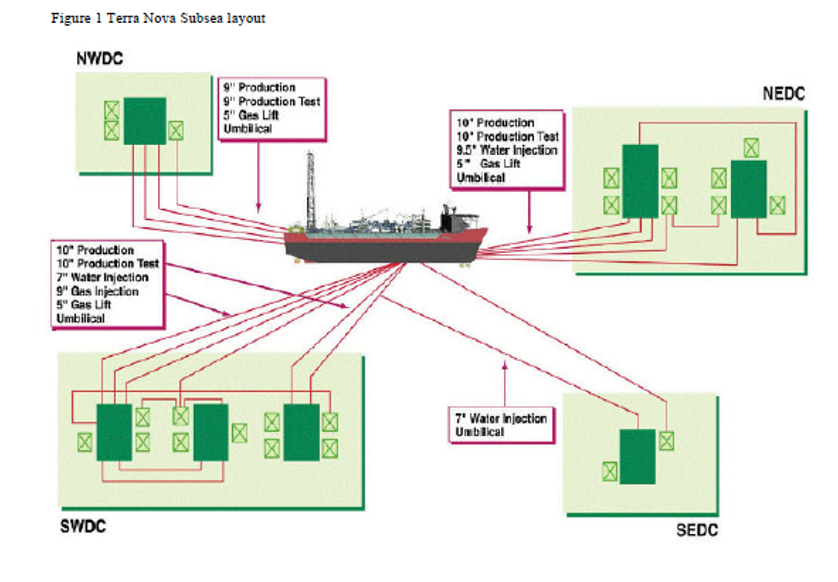
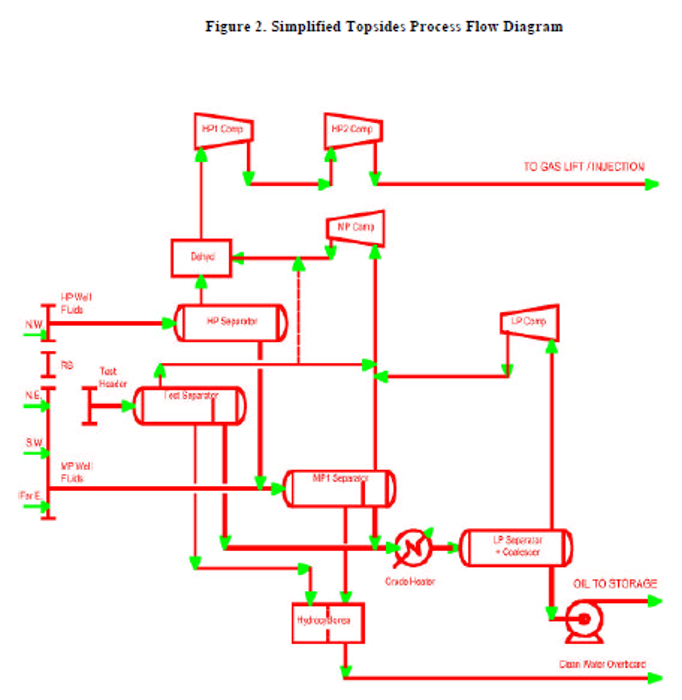
IntroductionThe Terra Nova development is based on a subsea tieback with flexible fowlines/risers to a Floating Production, Storage and Offloading (FPSO) vessel, with crude oil transported to market by shuttle tankers. The FPSO has a storage capacity of 970,000 barrels of oil and supports topsides process and utility equipment with a gross operating weight of 12,200 tonnes. The topsides facilities are designed for a maximum overall oil production rate of 23,880 Sm3/d (150,000 bbl/d), produced water rate of 21,000 Sm3/d (132,000 bbl/d), water injection rate of 28,600 Sm3/d (180,000 bbl/d) and gas injection rate of 7.36 MSm3/d (260 mmscfd). Following separation to meet the specifications for TVP of 75.8 kPa at 50 °C and BS&W of <0.5 % by volume, crude is transferred to the storage tanks located in the vessel hull where it is maintained above the wax appearance temperature at all times. The overall field schematic (base case development) is shown in Figure 1 and a simplified topsides process flow diagram is shown in Figure 2.
The base case subsea development scenario incorporates 14 production wells and 10 water/gas injection wells. Gas lift facilities are provided on 12 of the 14 production wells.
AbstractThe Terra Nova field is the second largest oil field discovered to date in the Jeanne d'Arc basin on the Grand Banks, with recoverable reserves of approximately 370 million barrels. The field, located in approximately 94 m of water 350 km East-Southeast of St John's, Newfoundland and 35 km Southeast of the Hibernia field, will be developed utilizing subsea flowlines from four drill centres tied back to an FPSO.
This paper discusses the design approaches adopted to meet the principal flow assurance challenges for the subsea facilities. These are:
- Hydrate formation: the minimum seabed ambient temperature is -2 °C.
- Wax formation: the design is based on stabilised crude having a wax content of 9.0 %, a pour point of 12 °C and a wax appearance temperature of 46 °C. The wax dissolution temperature is 70 °C.
- The implications of turret disconnection: the buoy along with all the risers can be released to allow the FPSO to move off-station to avoid icebergs.
The owners of the Terra Nova field are Petro-Canada (29 %), Mobil Oil Canada Properties (22 %), Husky Oil Operations Ltd. (17.5 %), Norsk Hydro Canada Oil and Gas (15 %), Murphy Oil Company Ltd. (12 %), Mosbacher Operating Ltd. (3.5 %) and Chevron Canada Resources (1 %). The operator of the field is Petro-Canada, and the FPSO vessel constructor is Daewoo of Okpo, South Korea.
The participants in the Terra Nova Project Alliance include Petro-Canada (and seconded owner personnel), Coflexip Stena Offshore Newfoundland Ltd., Shawmont Brown and Root, Halliburton Energy Services, FMC Offshore Canada Inc, PCL Industrial Constructors Inc. and Doris Conpro Ltd.
First oil from Terra Nova is targeted for January 2001.
IntroductionThe Terra Nova development is based on a subsea tieback with flexible fowlines/risers to a Floating Production, Storage and Offloading (FPSO) vessel, with crude oil transported to market by shuttle tankers. The FPSO has a storage capacity of 970,000 barrels of oil and supports topsides process and utility equipment with a gross operating weight of 12,200 tonnes. The topsides facilities are designed for a maximum overall oil production rate of 23,880 Sm3/d (150,000 bbl/d), produced water rate of 21,000 Sm3/d (132,000 bbl/d), water injection rate of 28,600 Sm3/d (180,000 bbl/d) and gas injection rate of 7.36 MSm3/d (260 mmscfd). Following separation to meet the specifications for TVP of 75.8 kPa at 50 °C and BS&W of <0.5 % by volume, crude is transferred to the storage tanks located in the vessel hull where it is maintained above the wax appearance temperature at all times. The overall field schematic (base case development) is shown in Figure 1 and a simplified topsides process flow diagram is shown in Figure 2.
The base case subsea development scenario incorporates 14 production wells and 10 water/gas injection wells. Gas lift facilities are provided on 12 of the 14 production wells.
AbstractThe Terra Nova field is the second largest oil field discovered to date in the Jeanne d'Arc basin on the Grand Banks, with recoverable reserves of approximately 370 million barrels. The field, located in approximately 94 m of water 350 km East-Southeast of St John's, Newfoundland and 35 km Southeast of the Hibernia field, will be developed utilizing subsea flowlines from four drill centres tied back to an FPSO.
This paper discusses the design approaches adopted to meet the principal flow assurance challenges for the subsea facilities. These are:
- Hydrate formation: the minimum seabed ambient temperature is -2 °C.
- Wax formation: the design is based on stabilised crude having a wax content of 9.0 %, a pour point of 12 °C and a wax appearance temperature of 46 °C. The wax dissolution temperature is 70 °C.
- The implications of turret disconnection: the buoy along with all the risers can be released to allow the FPSO to move off-station to avoid icebergs.
The owners of the Terra Nova field are Petro-Canada (29 %), Mobil Oil Canada Properties (22 %), Husky Oil Operations Ltd. (17.5 %), Norsk Hydro Canada Oil and Gas (15 %), Murphy Oil Company Ltd. (12 %), Mosbacher Operating Ltd. (3.5 %) and Chevron Canada Resources (1 %). The operator of the field is Petro-Canada, and the FPSO vessel constructor is Daewoo of Okpo, South Korea.
The participants in the Terra Nova Project Alliance include Petro-Canada (and seconded owner personnel), Coflexip Stena Offshore Newfoundland Ltd., Shawmont Brown and Root, Halliburton Energy Services, FMC Offshore Canada Inc, PCL Industrial Constructors Inc. and Doris Conpro Ltd.
First oil from Terra Nova is targeted for January 2001.
IntroductionThe Terra Nova development is based on a subsea tieback with flexible fowlines/risers to a Floating Production, Storage and Offloading (FPSO) vessel, with crude oil transported to market by shuttle tankers. The FPSO has a storage capacity of 970,000 barrels of oil and supports topsides process and utility equipment with a gross operating weight of 12,200 tonnes. The topsides facilities are designed for a maximum overall oil production rate of 23,880 Sm3/d (150,000 bbl/d), produced water rate of 21,000 Sm3/d (132,000 bbl/d), water injection rate of 28,600 Sm3/d (180,000 bbl/d) and gas injection rate of 7.36 MSm3/d (260 mmscfd). Following separation to meet the specifications for TVP of 75.8 kPa at 50 °C and BS&W of <0.5 % by volume, crude is transferred to the storage tanks located in the vessel hull where it is maintained above the wax appearance temperature at all times. The overall field schematic (base case development) is shown in Figure 1 and a simplified topsides process flow diagram is shown in Figure 2.
The base case subsea development scenario incorporates 14 production wells and 10 water/gas injection wells. Gas lift facilities are provided on 12 of the 14 production wells.
AbstractThe Terra Nova field is the second largest oil field discovered to date in the Jeanne d'Arc basin on the Grand Banks, with recoverable reserves of approximately 370 million barrels. The field, located in approximately 94 m of water 350 km East-Southeast of St John's, Newfoundland and 35 km Southeast of the Hibernia field, will be developed utilizing subsea flowlines from four drill centres tied back to an FPSO.
This paper discusses the design approaches adopted to meet the principal flow assurance challenges for the subsea facilities. These are:
Receive this Print
Send White Paper To Your Inbox
White paper 9826

1 Lorem Ipsum Dolor Sit Amet
R. Gibbons, Ballycatter.com**
* Specialist Production Engineer, Director
**Ballycatter.com, from Ballycatter Group,Inc, Canada
Copyright 2000, Onshore Technology ConferenceWhite Paper 9826
1 Lorem Ipsum Dolor Sit Amet
Document downloaded from www.ballycatter.com, best efforts have been made to verify information in this paper but no warranty, direct or implied, is provided, and the author is not. liable for the results of following advice and opinions expresssed in this document or any associated content.Based on original work OTC paper 9876322